The Reality Behind the Promise;
Universities stood at the threshold of transformation when regulators approved 126 institutions to launch ODL programs. The vision was beautiful. The reality was messy.
Within months, administrators faced an unexpected crisis. Dropout rates soared—ODL programs experienced 40-50% attrition compared to 15-20% in traditional classrooms. Instructors complained about invisible classrooms where real engagement felt impossible. Technology systems crashed. Compliance requirements tangled institutions in bureaucratic knots. And beneath it all, a fundamental question haunted leadership: How do we deliver quality education when the entire system was built for a different world?
This isn't a failure of ODL itself. It's the friction between vision and execution—and most institutions are unprepared for it.
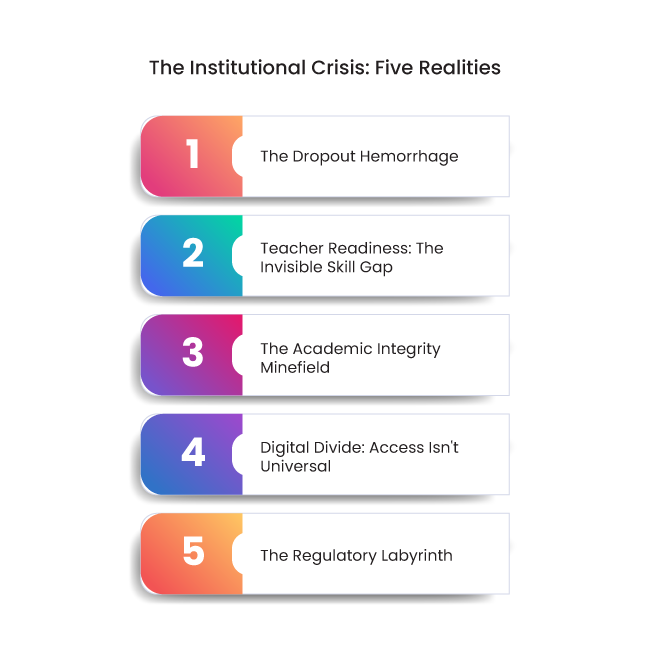
The Institutional Crisis: Five Realities
1. The Dropout Hemorrhage
When students engage with ODL, they face crushing pressures: work demands, family responsibilities, struggling internet connections, and the absence of peer accountability. But the real problem? Institutional barriers are primary culprits—inadequate support systems, weak advising relationships, and minimal academic handholding. When a working professional drops out after three months, the institution loses revenue, misses accreditation targets, damages reputation, and fails its mission.
2. Teacher Readiness: The Invisible Skill Gap
Your faculty designed brilliant curricula for classrooms. They've never taught at scale to invisible faces on screens. Most instructors struggle with ODL pedagogy—fostering meaningful interaction with 300 students online, designing self-directed learning, providing formative feedback, or detecting struggling students before they disappear. The result? Lectures uploaded to platforms. Students feel abandoned. Quality plummets. Additionally, institutions lack sufficient staff in critical areas—library support, ICT infrastructure, and student counselling remain chronically understaffed, amplifying the challenge.
3. The Academic Integrity Minefield
Without a proctor sitting across the exam table, how do you know the person taking your exam is actually your enrolled student?
Academic integrity terrifies institutions. Remote proctoring raises privacy concerns and technological complexity. Yet institutions cannot compromise standards without damaging accreditation and employer credibility. This tension paralyzes many programs.
4. Digital Divide: Access Isn't Universal
Your institution designed a compelling ODL program. Then you discovered 40% of target students in rural regions have unreliable internet. Some can't afford laptops. Others lack digital literacy and have never used learning management systems. When infrastructure assumptions don't match reality, entire student populations become invisible to your institution.
5. The Regulatory Labyrinth
India's UGC regulations on accreditation, NEP compliance, and quality assurance create a byzantine approval process that ties institutions in knots. Stringent requirements limit institutional autonomy. Compliance documentation consumes resources. Yet every institution must navigate this maze perfectly or face regulatory consequences that damage legitimacy.
Behind each challenge sits an institutional failure: inadequate support service mechanisms, poor management coordination, insufficient infrastructure investment, and absence of ODL-specific digital culture. Institutions typically launch ODL by simply uploading content to a platform. They don't invest in tutor training. They don't build dedicated support teams. They don't create early warning systems. They hope for the best and wonder why it fails.
How Winning Institutions Overcome These Obstacles
1. Build Comprehensive Student Support with Predictive Intelligence
Identify at-risk students at enrollment and connect them with academic coaches immediately. Invest in orientation courses, accessible tutoring, counseling, and peer-learning communities. MasterSoft's integrated platform uses predictive analytics to automatically flag disengaged students—monitoring login patterns, assignment submissions, and forum participation in real-time. Your support teams intervene before students disappear, not after. Our system coordinates all student touchpoints, ensuring advisors, counselors, and tutors work seamlessly together with sufficient capacity to genuinely support every learner.
2. Transform Teacher Preparation through Integrated Support
Provide intensive training on ODL pedagogy: facilitating discussions, designing assessments for deep learning, providing meaningful feedback. Create communities of practice where instructors learn from each other. MasterSoft's LMS includes built-in instructional design templates and best practices that guide faculty in creating engaging, self-directed learning experiences. Our platform reduces the technical burden so teachers focus on pedagogy, not wrestling with fragmented tools.
3. Implement Layered Academic Integrity Solutions
Use multiple mechanisms: secure exam software with identity verification, video-based proctoring for high-stakes assessments, diverse assignment types that reduce cheating opportunities. MasterSoft's assessment module integrates sophisticated proctoring capabilities, plagiarism detection, and identity verification—all within a single secure environment. Build academic integrity into institutional culture by training students about ethical expectations from day one through embedded compliance workflows.
4. Adopt Blended Learning as Transitional Strategy
Don't go 100% ODL immediately. Start with blended models combining face-to-face and online elements. MasterSoft's unified platform manages both synchronous in-person sessions and asynchronous online delivery seamlessly, reducing risk and allowing capacity building while serving students without reliable digital access.
Institutions learn as they scale, with built-in analytics showing what works in their specific context.
5. Eliminate the Regulatory Chaos
Navigate India's byzantine UGC regulations, NEP compliance requirements, and quality assurance mandates with confidence. MasterSoft's compliance module automatically generates required documentation, maintains audit trails, and tracks regulatory requirements across programs.
Our system ensures every institution meets stringent accreditation standards without consuming precious resources on manual compliance work. Generate compliance reports instantly instead of spending weeks assembling them.
The Integrated Solution: Why Fragmentation Fails
Here's the truth most institutions discover too late: You cannot build quality ODL on fragmented systems. Cobbling together separate tools for enrollment, learning management, assessment, proctoring, analytics, and compliance creates coordination nightmares where critical information gets lost between systems.
MasterSoft's integrated ODL platform eliminates this chaos entirely.
Everything—student support, teacher tools, academic integrity, regulatory compliance, and learning analytics—works together in one system designed specifically for institutional ODL success. Your teams spend time on what matters: education. Not firefighting disconnected technologies.
Click for a digitally empowered campus
 Author :
Gaurav Somani,
President Sales