The foundation of institutional success relies on coordinated workflow of different departments, budgeting, planning, and timely problem resolution. The HR department is integral to maintain operational efficiency by establishing accurate communication and resolving employee grievances.
Their responsibilities include onboarding, tracking attendance, calculating salaries, etc; however, executing them manually or using legacy systems is prone to errors. An HRMS software is an ideal solution that streamlines all HR-related activities.
What is HRMS Software?
HRMS or Human Resource Management System is a software solution that collects, organizes and maintains all employee-related data. It has a centralized platform which simplifies and executes attendance, payroll, compliance and leave management.
The software replaces spreadsheets and manual tasks and automates the entire employee lifecycle through a single consolidated system.
Essential Features of HRMS
Core HR
The core HR module stores and organizes all employee details, including their personal information, job details, employment history, family information, certificates, offer letters, contracts, etc.
Attendance and Time Tracking System
The software integrates with biometric devices, enabling employees to clock in and out, while also supporting RFID or smart card technology. The system allows the HR to get real-time data of employee working hours, days, overtime hours, and automatically calculates for payroll.
Leave and Time-Off Management System
The leave management system feature allows staff and faculty to apply for leaves through its different leave options (sick days, vacation, medical, etc). Once employees apply for the leave through the online portal, the authoritative personnel gets notification and approves or rejects accordingly.
Payroll Management
Timely disbursement of salary after accurate calculation of base salary, tax deductions, etc is central to the payroll management feature of the software. Additionally, it generates and sends and payslips, thereby saving HR’s time and ensuring employees get paid on time.
Recruitment and Hiring
The HRMS software comes with an integrated recruitment module, which automates the end-to-end recruitment process. Most modern systems come with features, such as job requisition management, resume parsing and shortlisting, interview scheduling, hiring pipeline tracking, etc.
Onboarding and Offboarding
The recruitment and hiring process connects automatically with the software and carries out the onboarding process, facilitating document collection, policy acknowledgements, asset allocation tracking, etc. At the same time, it enables the HR to complete the offboarding process by streamlining notice period tracking and final settlement processing.
Performance Management
The software tracks and records attendance, research contributions, student feedback, and workload completion, helping to carry out evidence-based performance reviews. Furthermore, the performance analytics generates performance reports, which comes handy during the appraisal periods.
Employee Self-Service
A self-service portal is an important module of modern HRMS software, which enables employees to check payslips and tax details, attendance, and apply for leaves. Additionally, they can update their personal information, and raise any issue or requests.
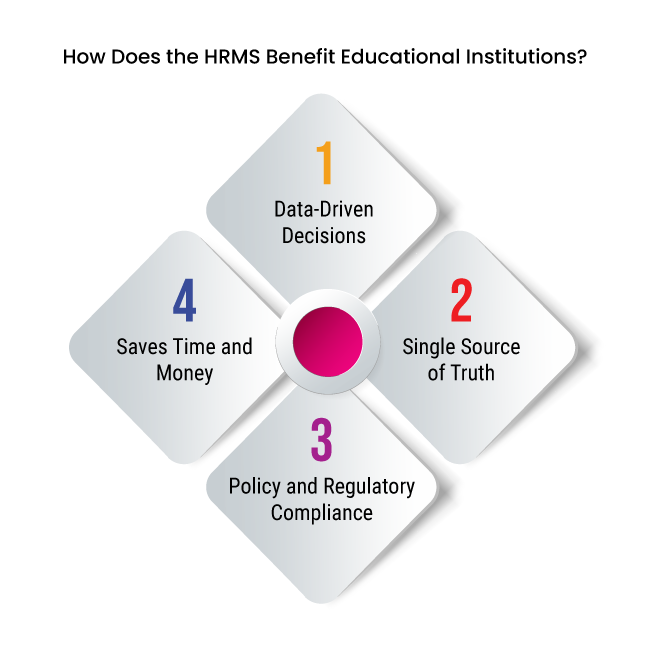
How Does the HRMS Benefit Educational Institutions?
Data-Driven Decisions
The system allows institute leaders to check the number of present and absent employees and track on-leave staff and faculty. They get real-time insights into employee turnover rate, payroll costs, etc and make data-driven decisions related to workload distribution, compensation structures, etc.
Single Source of Truth
Institute leaders and faculty do not need to access different systems or information systems to check relevant information. The system provides a single, unified platform that stores and maintains accurate data and enables faculty, HR managers, staff and institute leaders to access it.
Policy and Regulatory Compliance
All advanced tools like MasterSoft’s human resource management system incorporate employee data, attendance, payroll, etc within a centralized platform. In effect, it makes it easy to implement institutional policies consistently across the institute and it helps institutes to comply with tax rates and statutory deductions. The audit process completes seamlessly, while avoiding any government penalties.
Saves Time and Money
Previously the HR department had to complete most of the administrative activities manually, making it a time-consuming and exhausting practice. However, the HRMS automates repetitive tasks, including attendance and leave tracking, payroll calculations, data entry, etc. This not only saves time and money but also allows the HR department to focus on employee development and workforce planning.
Which is the Best HRMS for Educational Institutions?
The HRMS system seeks to elevate core HR activities of institutions: hence, choosing the right one instrumental. Consider the following factors while choosing an HRMS.
Identify Specific Issues
Each institute encounters specific issues that require thorough analysis and appropriate solution; hence, identifying the major HR-related issue is the first step. For instance, it could be recurring employee complaints regarding payroll errors, attendance data discrepancies, etc.
Cloud-Based Infrastructure
Cloud technology has become central to modern technology and modern HR software are cloud-enabled, which ensures secure data backups and automatic updates. Institute team members can access data anytime, anywhere with valid credentials; plus it reduces IT dependency.
Scalability
An educational institution strives to grow with each academic year and it requires a reliable software solution that can accommodate varied organizational needs. Hence, choose a scalable tool that adapts quickly and integrates with other systems.
Data-Driven Analytics
Tracking on-going institutional operations and detecting procedural issues is important, which is how AI-powered systems perform. For instance, MasterSoft’s College ERP suite provides integrated HRMS, which leverages intelligent applications and data-driven analytics to carry out performance reviews, retention forecasting, and performance monitoring.
Final Word
Human resource management system has become an indispensable assistive technological tool as it streamlines core HR activities. Furthermore, it scales simultaneously as the institute expands and helps to conduct performance management and appraisals and training/development.
Click for a digitally empowered campus
 Author :
Gaurav Somani,
President Sales