Students’ evolving needs, low attendance, increasing dropout rates, and reduced participation in certain classes are significant challenges for higher education institutions. Anticipating or detecting them and employing necessary measures is the need of the hour, which is difficult without technological support.
The solution? AI-driven predictive analytics, which utilizes data-based strategies to provide real-time information about student performance and overall institutional operations. In effect, institutions can provide proactive support systems instead of reactive crisis management.
But what is Predictive Analytics in Education? Let us explore
Predictive Analytics in Education
Predictive analytics is an advanced feature of the core modules of ERP tools, such as student information systems and learning management systems. It analyzes student-related data, including academic performance, attendance, assessments, and in-class participation.
The feature utilizes machine learning and statistical models to identify patterns, trends, and warning signals. In effect, teachers can rely on real-time information to provide targeted learning support, whereas students get timely guidance and feedback.
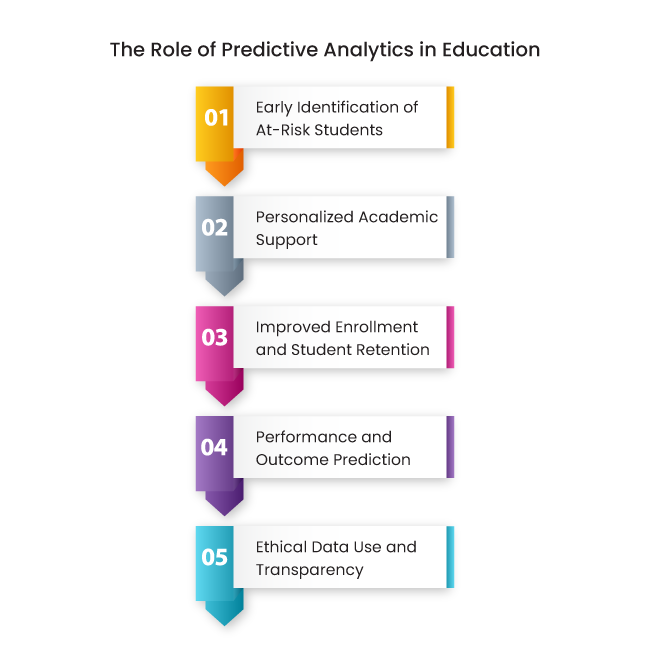
The Role of Predictive Analytics in Education
Early Identification of At-Risk Students
Students’ failure to keep up with the pace of the rest of the class or continuing to underperform in tests are more likely to disengage. Also, students are more likely to miss classes when there is little to no effort made to tackle their poor attendance and academic performance.
Teachers can use the SIS tools that come with AI-powered predictive analytics, which detect academically struggling students early on. For instance, the tool tracks and flags frequent absenteeism, poor engagement, and low grades.
Additionally, developing an intervention strategy and involving respective parents is a proactive way to help the at-risk students.
Personalized Academic Support
A student encountering difficulty in understanding the theories of physics might differ from another student who might struggle with arithmetic. What’s more, the one-size-fits-all approach has been the most common instructional method, which does not cater to students with varied learning needs and habits.
On the contrary, modern tools like MasterSoft’s student information system have built-in predictive analytics, which analyze assignments, assessments, learning habits, tests, and engagement timelines. In effect, it sends targeted learners support in the form of appropriate study materials, remedial programs, instructional videos, etc.
Improved Enrollment and Student Retention
How can institutes improve student retention? A common question that often institute leaders or faculty think about. The answer lies in finding out the factors behind frequent absenteeism and implementing relevant measures.
Institute stakeholders can take advantage of the SIS software to identify the attendance patterns and engage with students early on. They can employ data-driven academic advising or counseling, enabling students to express their concerns and get appropriate feedback and assistance.
On the other hand, institute stakeholders can leverage accurate data on admission trends, in-demand courses/programs, and allocate resources accordingly.
Performance and Outcome Prediction
Reviewing and monitoring individual students’ performance regularly is quite challenging for faculty; nevertheless, they can use the tool to get data-driven insights. The AI-powered SIS collects, organizes, and analyzes assessment grades, attendance data, engagement levels, etc.
The system runs continuous analysis and generates accurate data on assignment submissions, class or batch-wise performance reports, graduation completion, etc.
For instance, they can consider curriculum adjustment and academic advising, and prioritize targeted support. Besides, since accurate data is central to this approach, it ensures strategic student support, better resource planning, and successful academic outcomes.
Ethical Data Use and Transparency
Day-to-day data collection and management are common yet critical administrative activities of an educational institution. The lack of data security can make sensitive information prone to cyber threats and unauthorized access.
AI-powered tools have built-in security features, including data encryption, role-based access, and cloud-based features. Therefore, when institutes adhere to data regulations and establish transparent data governance with the help of the tool, it helps to maintain ethical data use.
Conclusion
Maintaining student success relies on not just on effective teaching delivery, but also identifying recurrent difficulties and frequent absenteeism. Predictive analytics is an advanced feature of modern ERP tools that institutes and faculty can leverage to track student performance and make data-driven decisions.
Click for a digitally empowered campus
 Author:
Prashant Borkar,
Vice President and Product Head