Adopting new and innovative teaching and learning strategies is key to improving the quality of education and ensuring better learning outcomes. Hybrid learning is one such method that has been witnessing growing popularity as it adapts to diverse learning preferences.
Although hybrid learning has notable advantages, it poses certain challenges, which might make it difficult for students and institutions. Operational issues are the major obstacles that institutions can overcome through a robust ed-tech solution.
But what is hybrid learning, and how is it different from other educational models? Let us find out:
Exploring Hybrid Learning
Hybrid learning is an exemplary educational model that leverages in-person and digital learning to provide an engaging educational experience. It is highly adaptable for Higher education, K-12 education, and professional training and development.
Hybrid learning differs from blended learning through its emphasis on synchronous methods, wherein teachers incorporate direct classroom and live virtual instruction simultaneously. For example, teachers explaining biochemical processes can include videos or 3D simulations, which can provide an in-depth understanding.
The educational model offers various advantages, but it also poses notable challenges that can make it difficult for teachers and students alike.
What are these challenges, and are there any solutions that can possibly lead to student success? Let us find out:
Challenges of Hybrid Learning
Digital Divide
Technology has elevated the education system vastly, enabling higher educational institutions to expand and reach a diverse student population. However, geographical areas with low internet bandwidth, connectivity issues, and students from disadvantaged backgrounds often encounter the digital divide.
Collaborative efforts of institutions and government initiatives, including infrastructure expansion, digital literacy, and training, are notable measures to mitigate the issues.
Lack of Social Interaction
Hybrid learning lessons include in-class sessions, yet peer-to-peer engagement is relatively low in comparison to traditional educational settings. In effect, students might feel isolated and disengaged, especially those who participate in online settings.
Lack of Self-Discipline
One of the major advantages of the learning model is that it is self-paced, enabling students to master a topic at their own pace. However, it can gradually become a disadvantage, especially if students do not maintain self-discipline and give in to distractions.
At the same time, it is crucial that students strive to manage time effectively and stick to a daily routine, which can help them progress.
Assessment Limitations
Online examinations have become a crucial component of the academic process, and they add value to the hybrid learning model as well. However, the integrity of digital assessments is always under scrutiny due to the lack of effective security mechanisms.
This is where educational institutions can adopt MasterSoft’s offline and online exam management software, a part of the Education ERP suite. The system not only simplifies end-to-end assessments but also proctors online exams in real-time.
Resource Requirement
Appropriate investment in technological tools, teacher training, continuous monitoring, student support, and conflict resolution is central to student success. Many institutions may not be able to allocate certain resources at the right time, leading to obstacles that can hinder the teaching and learning process.
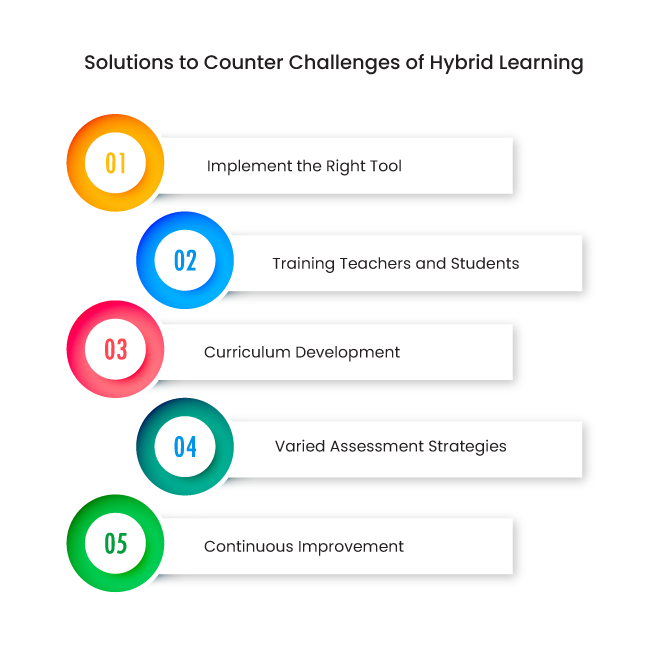
Solutions to Counter Challenges of Hybrid Learning
Implement the Right Tool
Selecting the right tool, such as a learning management system, is key to planning and executing successful hybrid learning sessions. The system helps to collect, manage, and share various educational resources, such as PDFs, videos, articles, and send assignments and notifications.
In effect, students can access learning materials digitally, without worrying about missing classes or notes. They stay updated with the latest developments in the classroom and prepare accordingly.
Training Teachers and Students
The success of an educational model relies on whether or not students and teachers can grasp it and engage with it proactively. Therefore, institutions must carry out essential training for teachers and students, helping to familiarize them with the new tools.
Whether using the LMS platform or the online exam software module, learning the basic features helps to navigate them without any confusion.
Curriculum Development
What elements of the topic must include online elements, and what topics must be covered in the class? Considering such questions is critical to develop a curriculum that can help to strike a balance between online and in-person learning.
What’s more, clarifying the learning objectives and including various strategies, like project-based learning, can foster critical thinking and self-learning.
Varied Assessment Strategies
One of the best advantages of hybrid learning is that teachers can implement different types of examinations to assess students’ knowledge and understanding. Some of the tactful assessments that they can implement both online and offline are self-assessments, presentations, projects, etc.
Continuous Improvement
Identifying whether students are performing well or not lies in monitoring them continuously, which teachers can do by collecting feedback. By the end of each class, students can share their key takeaways as well as their struggle points, providing teachers with useful insights.
On the other hand, the feedback can inform teachers of the common challenges or patterns that lead to recurrent issues, urging them to make necessary adjustments.
Final Thoughts
Hybrid learning and blended learning are often considered to be the same; however, they differ in terms of the usage of online learning elements. Hybrid learning blends digital elements within in-person learning. It requires proper infrastructure, resources, and continuous monitoring to ensure student success.
Click for a digitally empowered campus
 Author :
Gurudev Somani,
CEO & Co-founder