A post-graduate and undergraduate degree does not necessarily guarantee employability in the Philippines, especially when candidates do not possess the required skills. Skill mismatch is one of the primary reasons why fresh graduates often encounter employment issues.
On top of that, contractual or short-term employment creates job insecurity — that is why microcredentials are gaining popularity in the country. The Philippines Qualifications Framework (PQF) emphasizes the significance of microcredentials across higher educational institutions.
Discovering Microcredentials
Microcredentials are short focused courses or credentials that target specific skills and competencies that students learn through structured learning modules. Colleges, universities, training providers, and government agencies offer microcredentials.
These courses are usually a few weeks or months long and serve to bridge the gap between industry demands and workforce skills. Sectors like digital marketing, IT, and technical-vocational fields are among the primary areas of focus. Regulatory bodies including CHED and TESDA recognize microcredentials as a valid learning module. When institutes align with PQF, it indicates that their programs adhere to pre-established standards of quality and excellence.
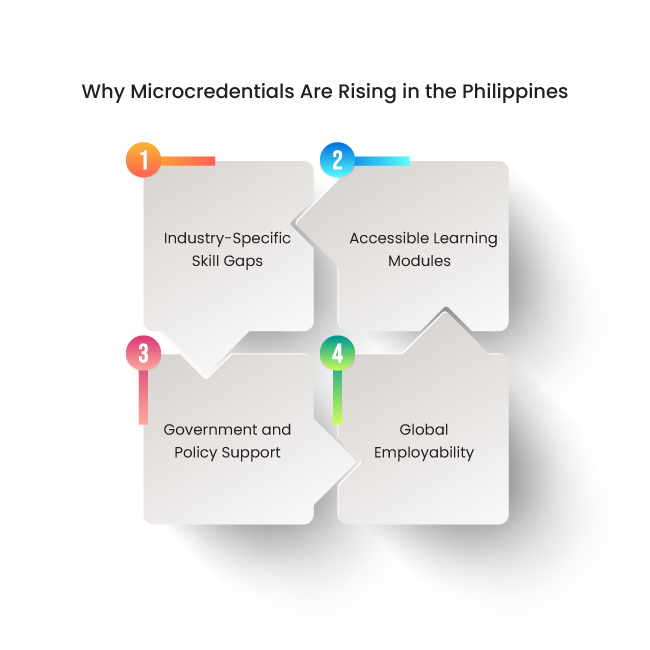
Why Are Microcredentials Rising in the Philippines?
Industry-Specific Skill Gaps
Organizations and employers strive to hire candidates who possess relevant skills; however, the workforce lacks technical and digital skills necessary to function effectively. Traditional education often fails to prepare students for evolving economic and job demands unless it incorporates effective industry-academia collaboration.
Employers value skills, and candidates who can demonstrate specific competencies are more likely to secure employment. Microcredentials enable individuals to attain knowledge and mastery in varied areas, reducing hiring risk.
Accessible Learning Modules
TESDA and major universities provide microcredentials in affordable, online learning modules — officially supported through CHED (CMO No. 1, Series of 2025). These are cost-effective and allow learners to progress at their own pace, making them ideal for working professionals, returning OFWs, and out-of-school students.
Government and Policy Support
The Philippine Government has been increasingly advocating microcredentials. CHED plays a key role in integrating microcredentials in higher education through the PQF, with new guidelines requiring universities to adhere to specific PQF levels — ensuring students receive top-notch education and training.
Global Employability
Universities and government agencies have designed learning models in response to local and global skill demands. Industry collaboration is central to these courses, helping address skill gaps in the labor market. Students also receive verifiable digital credentials or badges after completion, which they can showcase internationally.
Importance of PQF Alignment
The Philippine Qualifications Framework (PQF) provides a constructive structure for educational qualifications and competencies. Higher education institutions rely on this structure to classify education levels, training, and work experience against specific learning outcomes and industry standards.
The framework includes eight qualification levels — from basic skills to advanced professional qualifications like the doctorate. PQF is one of the government's foremost initiatives for workforce development and skill enhancement.
The PQF National Coordinating Council (PQF-NCC) serves as the policy-level coordinating body for implementation. CHED utilizes the framework to embed microcredentials within higher education. Universities align microcredentials in the following ways:
Mapping to a PQF Level
Universities analyze and establish the complexity levels of skills and knowledge, comparing learning outcomes with PQF level descriptors. Programs are mapped to an appropriate level, ensuring microcredentials match a recognized competence level.
Outcome-Based Design
PQF follows an outcome-based education approach, wherein microcredentials define clear measurable outcomes and identify categories of knowledge including technical, theoretical, and applied competencies. The learning model includes self-learning materials and structured activities that establish a clear level of learner autonomy.
Universities can leverage integrated academic solutions such as MasterSoft's Learning Management System to operationalize PQF-aligned microcredentials — mapping learning outcomes to qualification frameworks, structuring outcome-based assessments, maintaining supporting academic documentation, and monitoring attainment across courses and credential pathways.
Competency and Industry Standards
PQF alignment ensures that universities creating microcredential models focus on skills that match industry requirements and standards. Programs are planned, designed, and implemented according to national training regulations.
Quality Assurance and Documentation
Systematic quality assurance and accurate documentation is a key aspect of PQF alignment. Transparent certification details, well-defined assessment criteria, and a structured curriculum support the microcredential course validation process.
Institutions can further strengthen these processes through MasterSoft's Student Information System — centralizing credential records, assessment evidence, outcome attainment, and reporting to demonstrate compliance and support long-term institutional credibility.
CWhat Comes Next for Philippine Higher Education
As the Philippines continues responding to changing workforce expectations and global skills mobility, microcredentials are likely to become an increasingly important part of higher education strategy — rather than an alternative pathway. Their long-term value, however, will depend not only on accessibility but on how effectively institutions align learning outcomes, qualification standards, and credential recognition through frameworks such as PQF.
Frequently Asked Questions (FAQs)
Yes. Microcredentials support continuous upskilling and reskilling by allowing learners to build competencies incrementally over time. Instead of returning to full-time degree programs, individuals can pursue targeted credentials at different career stages and adapt to changing industry requirements.
Institutions can measure effectiveness through indicators such as learner completion rates, employment outcomes, industry partnerships, credential utilization, progression into advanced study, and learner satisfaction. Long-term tracking helps determine whether credentials are generating measurable workforce value.
No. Although professionals often use microcredentials for career advancement, these learning pathways can also benefit undergraduate students, career shifters, returning learners, and individuals seeking specialized competencies before entering the workforce.
Employer participation helps institutions ensure that microcredential content reflects current market expectations. Industry consultation, co-designed curricula, and competency validation can strengthen the relevance and acceptance of credentials across sectors.
Sustainable implementation requires clear governance models, outcome tracking, digital credential management, quality assurance processes, and integrated academic systems that support curriculum administration and long-term credential recognition.
Click for a digitally empowered campus
 Author :
Gaurav Somani,
President Sales