In 2026 the microlearning market size has reached USD 3.3 billion and it will further at a 11.83 percent CAGR to USD 5.81billion by 2031. The rising trend for microlearning is due to the increasing demand for skill-based learning, which is the cornerstone of the modern education system.
Investment in robust technological solutions is instrumental to implementing microlearning as a part of the teaching and learning process. The second and imperative step includes breaking down a subject topic into fragmented units.
But what is microlearning and why has it become important for the modern education system? Let’s find out:
What is Microlearning?
Microlearning is an educational strategy which breaks down educational material into small, bite-sized content, making it easy for learners to understand. It targets a single concept of skill that one can present within a composite learning unit.
Microlearning sessions have emerged as a useful tactic to make learning more convenient and student-friendly, which is integral to encourage learner engagement and active participation.
Therefore, educators can utilize digital platforms to create elaborate microlearning sessions and implement them as a part of the regular learning process.
Types of Microlearning
Infographics
Infographics include visual data, images, designs, graphical representations, elements, etc and makes the learning material easily understandable. Faculty can use it to make difficult or complex concepts simple with the help of specific icons, pictures and texts.
Students can refer to infographics to identify the connections between concepts or revise before examinations.
Simulation
Simulations utilize AR/VR (Augmented Reality/ Virtual Reality) platforms to create 3D models and animations to describe a topic or concept. Students can interact with the learning content; for instance, they can observe and identify different organs of a human or animal body.
Likewise, engineering students can take part in a fully simulated environment, wherein they can identify technical flaws and evaluate spatial relationships. In effect, it reduces the need to allocate physical prototypes.
Gamification
Gamification is an innovative way to make the learning process a fun experience for learners by integrating elements like badges, points, bonuses, games, etc. Adding a leaderboard is another example, which urges students to complete a task, assignment, or project to score higher in the leaderboard.
Video-Based Learning
Student’s response to a learning material might not be the same; some may prefer texts, while others grasp concepts quite promptly to videos or audios. Video-based learning is one such approach which uses instructional videos, documentaries, interviews and movies to get interesting insights into varied topics.
However, faculty can leverage MasterSoft’s learning management system to incorporate short video clips to highlight the main points of a subject matter. Additionally, they can allocate it as an additional learning resource.
PDFs
PDFs and ebooks are rich sources of information that allow teachers and students alike to learn and conveniently. They can access them from anywhere anytime; also, they can read and glance through a specific part of the content as per their requirement.
Quizzes
One of the most important microlearning techniques is quiz, which teachers can use as a way to review students’ ongoing progress. Simultaneously, students can self-assess and evaluate their understanding of the subject material and concepts that have been covered so far.
Podcasts
Podcasts are audio-based learning content, which students often listen to get brief ideas about events, theories, and ideas.
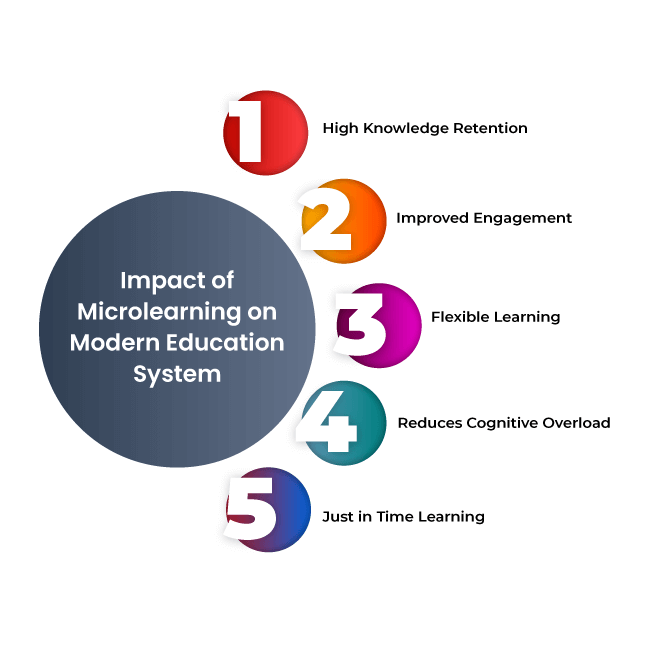
Impact of Microlearning on Modern Education System
High Knowledge Retention
Traditional learning habits often include rote memorization, which does not add to the learning experience. In contrast, the availability of varied learning techniques, enables students to choose their preferred method, which helps to understand, helping to remember and retain knowledge effectively.
Improved Engagement
One of the best ways to increase the engagement quotient in the classroom as well as outside the classroom for students is by incorporating multimedia. The integration of videos, infographics, audios, etc, transforms learning into an interactive experience.
Whether it is listening to podcasts, answering pop quizzes, or watching video clips, students learn actively. What’s more, students often find themselves enjoying and learning new things, without undergoing information fatigue or mental exhaustion.
Flexible Learning
A smart phone or tablet is the only thing that one requires to complete a five minutes of microlearning session. The learning sessions are bite-sized, making it practical for university students or working professionals doing courses or training to complete their daily learning bits.
Reduces Cognitive Overload
Cramming information as much as one can to and attempting to retain it can lead to cognitive overload, making the educational process tiresome and tedious. In contrast, microlearning breaks down information into smaller chunks, making it easier for students to respond.
Furthermore, when students take active interest in the learning process, they learn instinctively, which also improves their cognitive abilities.
Just in Time Learning
Going through the class’ notes, assignment to clarify doubts on certain topics is time consuming. However, when students get accurate information at the time when they need it, it helps them get an appropriate solution promptly.
This is where Mastersoft's LMS software proves to be a necessary tool as it provides a platform for students to get access to instant feedback activities, quick reference guides, infographics, etc.
Conclusion
Microlearning is an educational strategy that dissects learning material into small manageable chunks through texts, graphics, videos, quizzes, games, etc. Microlearning sessions have been designed to target specific subject topics, enabling students to learn at their own pace. Hence, it helps to instill continuous learning.
Click for a digitally empowered campus
 Author:
Prashant Borkar,
Vice President and Product Head